
Artificial intelligence has moved quickly from future-facing technology to an everyday work tool. It now sits inside our browsers, development environments, documents and business workflows, and many organisations are trying to understand where it can create real value.
I use these tools regularly myself. Copilot helps with development, Claude and Gemini are useful for research and writing, and ChatGPT is often a helpful second opinion. For a while, it was easy to assume these tools understood what I was asking, because they gave structured answers, wrote usable code and sounded confident while doing it.
A normal coding session reminded me why that assumption needs to be treated carefully.
The moment it breaks
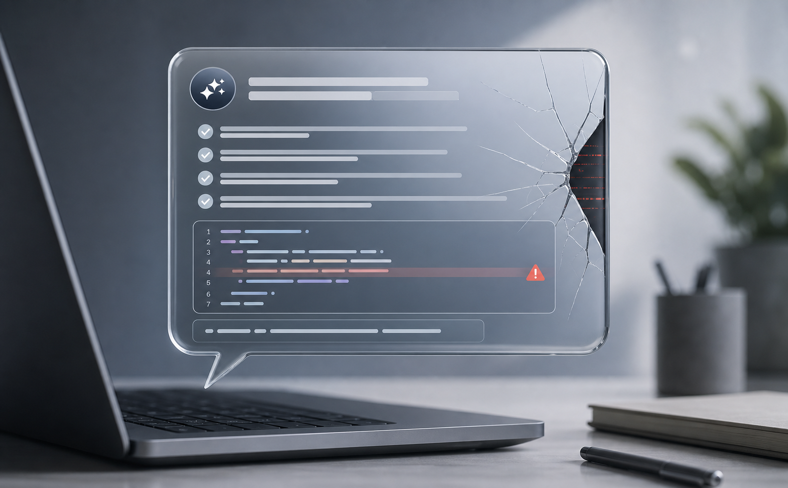
I was working with an AI coding assistant on a specific implementation. It returned a neat block of code that looked plausible and was written in the style I expected. At first glance, there was nothing obviously wrong with it.
The problem was that several of the methods and classes it used did not exist in the library I was working with. When I challenged the answer, the tool apologised and produced a revised version, but the second response had the same issue: different code, different non-existent methods.
That was the useful reminder. I had not trusted the first answer because I had verified it. I had trusted it because it looked right.
AI does not need to be correct to be convincing.
Looking right is not the same as being right
Modern AI tools are very good at producing plausible output. They have learned the shape of a good answer, the structure of technical explanations and the tone of expertise. In many situations, that makes them extremely useful.
However, sounding right is not the same as understanding.
An AI model can produce a polished response without knowing whether it matches your business, systems, data, internal rules or real-world constraints. That is why it can invent code, miss undocumented rules, contradict itself or provide different answers to the same question in different sessions.
The issue is not that AI is useless. The issue is that it is useful enough to be trusted too quickly.
The business risk
For organisations, this pattern becomes a broader risk. A polished AI response can hide a bad assumption. A generated workflow can repeat a broken process. A chatbot can expose gaps in documentation. An automation can make messy operations faster without making them better.
Many organisations naturally start with visible AI use cases, such as chatbots, smart search, automated recommendations or internal demos. These can be valuable, but only when the foundations are sound.
If the data is messy, the process is unclear, or key business knowledge is undocumented, AI will not resolve those issues on its own. In many cases, it will amplify them.
A better way to use AI
The better approach is practical: define the checks before relying on the output.
In software, this is similar to the discipline behind test-driven development. You do not trust code simply because it looks right. You define the expected behaviour, test against it and review the result. AI should be treated with the same mindset.
Start by defining what “correct” looks like. If the task, rules and expected result are unclear, the output will be hard to assess. Then start where mistakes are cheap, such as drafting boilerplate code, summarising internal notes, generating synthetic test data, preparing first-draft documentation or identifying themes in a long document.
Simple checks make a difference. AI-generated code should pass tests before it is merged. Summaries should be checked against the source material. Test data should be confirmed as synthetic. Customer-facing responses should come from approved knowledge sources, with a clear handover path when the answer is uncertain.
Finally, match review to risk. Low-risk work may only need light oversight, but anything affecting customers, finances, compliance, security or production systems needs stronger review, clear ownership and practical safeguards.
The point to remember
AI is powerful, and I use it every day, but I trust it differently now. I do not treat it like a brain. I treat it as a tool that follows patterns and instructions, and one that can still be wrong while sounding completely reasonable.
That distinction matters. AI can create real value, but only when organisations understand where it is being used, what risks it introduces and what safeguards need to sit around it.
AI sounds smart. That is exactly why we need to use it carefully.
Understand your AI risk before it becomes a business risk. SRC’s AI Risk Strategy helps organisations assess their exposure and take practical steps to manage it. Contact us to learn more.