
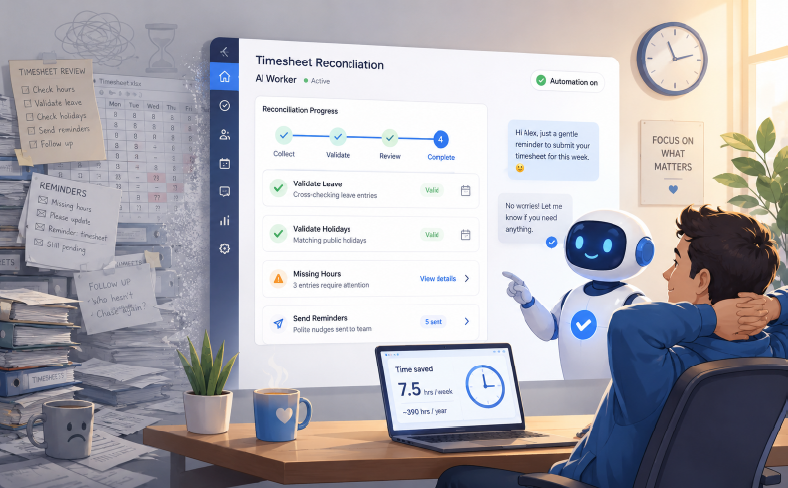
Every HR and Admin team knows the end-of-month payroll cycle. It’s full of chasing down missing timesheets, cross-referencing messy spreadsheets and pinging unresponsive employees who forgot to log their hours. And it happens every single month.
To solve this problem for SRC Innovations, I built MyTime, an autonomous AI Compliance Worker designed to turn the chaos of missing timesheets into a hands-off automated workflow.
The cost of missing hours
It might not seem like a big deal, but missing timesheet hours was a real pain point for SRC. Before MyTime, reconciling timesheets was a manual burden for our admin team. You’d have to:
- Check each employee’s hours to see if they have logged them all
- If the employee is missing hours, check if they were on leave for those hours
- Check if missing hours can be attributed to public holidays
- Send Slack messages and email reminders nagging employees to enter missing timesheets
Not only is this a waste of our time, but constantly messaging employees on busy schedules at random times was testing of their patience too. We needed a new system that could intelligently bridge the gap between our internal timesheet database, payroll, employee leave calendars, and Slack. This would completely eliminate the need for constant human oversight and free us up to do more valuable work.
An agentic cross-platform AI worker
Instead of building a rigid, hard-coded script, I designed MyTime as an agentic compliance worker. It operates on a proactive weekly schedule, functioning as an intelligent auditor with built-in guardrails to ensure its success.
How it works (the core logic)
Audit: Every week, MyTime scans the internal database to ensure designated employees have met their minimum weekly working requirement (typically 40 hours, but less for non full-time employees).
Validate & Contextualise: If a gap is found, the agent doesn’t just blindly sound the alarm. It cross-references our leave calendar and the public holiday calendar (tailored to the employee’s location). If an employee was on leave or a public holiday occurred, it automatically adjusts expectations and logs their leave on their behalf.
Resolve via Smart: If a gap remains truly unexplained, MyTime sends a personalised Slack nudge directly to the employee.
Implementation problems & solutions
Integrating MyTime across the internal database and Slack required solving a complex scheduling edge case for part-time and flexible staff. Because these employees don’t work a traditional 8-hour, 5-day week, the initial system flagged missing timesheets on short days, even if the weekly hours were correct. To fix this, the algorithm was refined to map leave and missing hours strictly against each employee’s unique working-day profile rather than a static 40-hour template.
Additionally, managing the token cost of constant AI auditing meant structuring a strict, tiered schedule (Monday, Wednesday, Friday scans) rather than real-time monitoring, ensuring high efficiency without runaway API bills.
No more missing timesheets
By offloading the auditing and chasing to MyTime, we achieved massive improvements in operational efficiency and data accuracy.
- Before: Reconciling timesheets and chasing team members took hours of fragmented attention from our admin team every single week.
- After: Almost no manual labour is required to reconcile timesheets and get payroll out the door.
Perhaps most importantly, we freed up time for our admin team to focus on more important tasks than chasing timesheets.
Preservation of the “human touch”
By automating routine reminders from your boss to complete timesheets with a polite AI Slack assistant, we removed friction between management and staff. Humans intervene only when a real problem arises, not when you forget to enter timesheets during a hectic week.
What did I learn?
Building MyTime was a great experience for me because it drove home a big lesson: the true value of the tools we build isn’t just about automation, it’s about the end-user experience (in this case, WE are the users).
I started with a script just assumes everyone fits into a neat little box. But real life is messy. People have flexible schedules, unique leave-logging habits, and different public holidays depending on where they live. By shifting from a basic, traditional rule-based script to an intelligent AI workflow that actually looks for context before it sounds the alarm, the system went from being a annoying HR tool to a real time-saver. It taught me that successful AI tools need to adapt to human quirks, not force humans to adapt to the software.
Built using Node.js, Slack Bolt.js framework, Slack Block Kit API and Calendar integrations.
Stop chasing. Start automating.
SRC Innovations can help your organisation design and deploy AI workers that handle repetitive operational tasks, from reconciliation and reminders to workflow monitoring and exception handling.
Get in touch to discuss what an AI worker could do for your business.